Drawer Organisers in Singapore: How Deep, Wide, and Tidy Can Your Drawers Actually Get?
What depth and width of drawer organiser actually fits Singapore HDB and condo drawers?
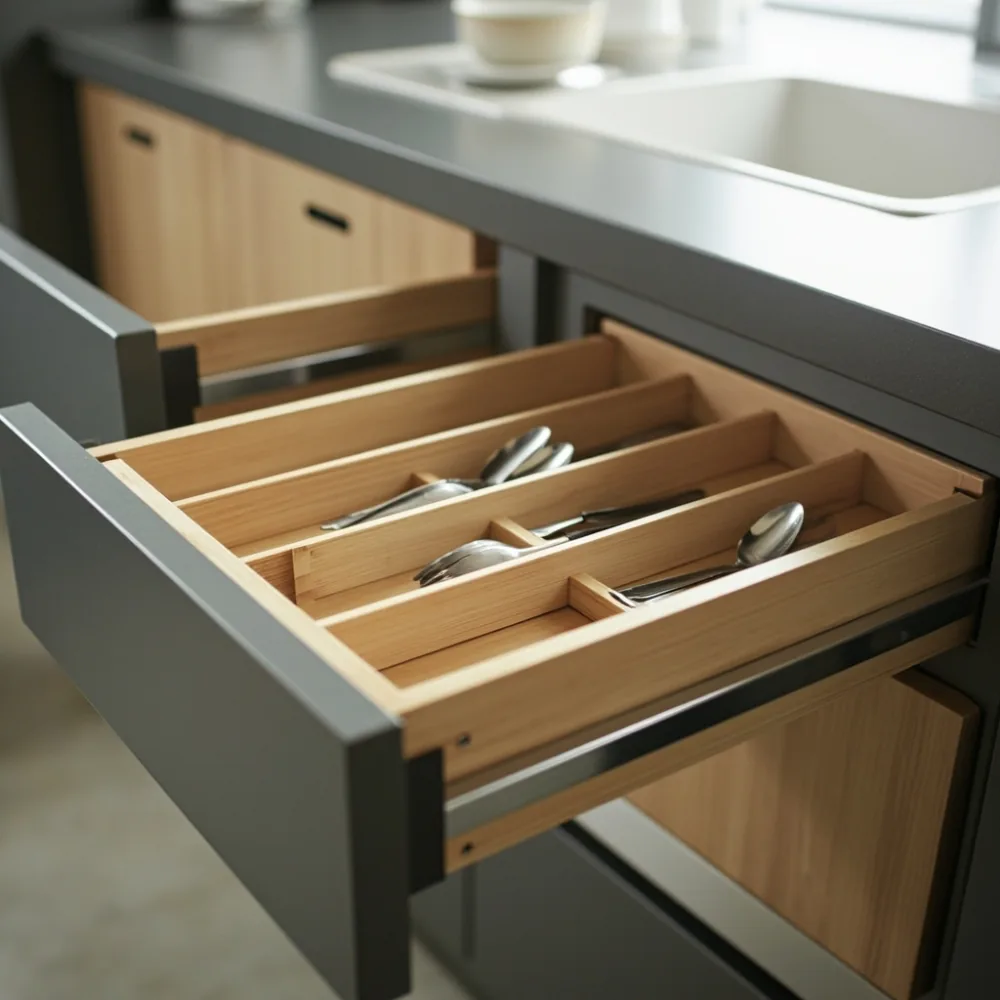
I have measured more kitchen and wardrobe drawers in HDB flats and condo units than I would like to count, and the single biggest mistake people make is buying an organiser from an overseas listing that lists "standard" dimensions that simply do not exist here. Most HDB kitchen drawers from BTOs, resale flats, and the common Designmine 1100 series sit at an internal clear depth of 460-500 mm and an internal clear width of 360-440 mm for the small drawer and 700-900 mm for the large drawer. Condo built-ins tend to be a touch shallower at 420-480 mm because of the soft-close runners. Tall wardrobe drawers in master bedrooms are usually 400-450 mm deep and 500-800 mm wide.
Before you click add-to-cart, pull out a measuring tape and check three numbers: the internal width at the drawer front, the internal depth from the drawer face to the back wall, and the internal height from the drawer base to the underside of the drawer top. That last number matters if you are stacking a utensil tray under a false bottom or fitting a deep drawer organiser for pots. I have seen people buy a 550 mm deep bamboo tray for a 470 mm deep HDB drawer, and the answer is always the same: it does not fit, and it scratches the back of the cabinet when you push it in.
If you are kitting out a whole flat, a small space furniture approach helps: pick one width (say 380 mm) and one depth (say 460 mm) and standardise every kitchen and bathroom drawer around those two numbers so you can swap trays between rooms when life changes.
Does Singapore humidity actually warp bamboo, plastic, and solid wood drawer organisers?
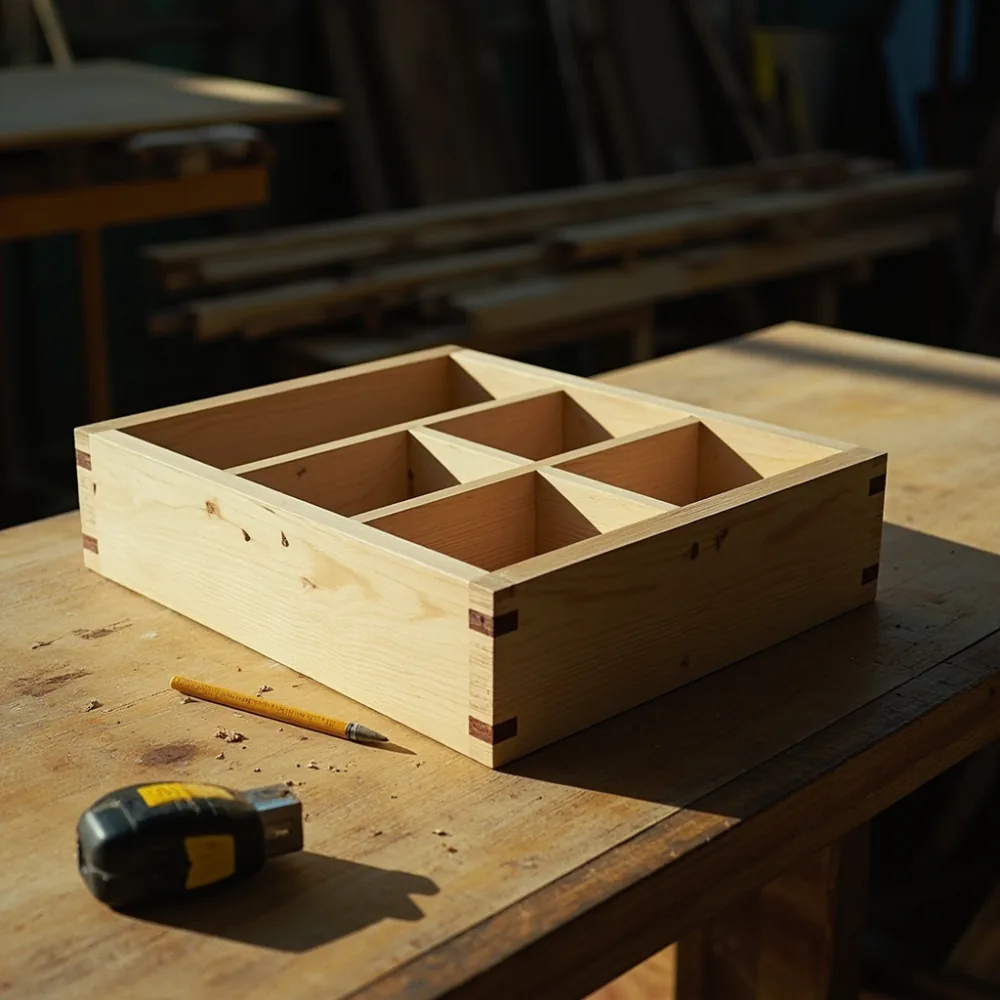
Yes, but the severity depends on the material and the build. I keep an AcuRite digital hygrometer in my bedroom and another in the kitchen; bedrooms hover around 65-75% RH most nights and the kitchen near the window climbs to 78-82% on wet afternoons. Those numbers matter because the moisture content of wood is roughly in equilibrium with that relative humidity.
Thin bamboo trays under 10 mm thick are the first casualties. The cross-glued layers swell unevenly, the corners gap, and within 9-12 months you see daylight through the joints. Thick bamboo (15-20 mm) with a proper lacquer seal holds up much better, but if you are after something that genuinely lasts in a coastal district like Marine Parade or Sentosa Cove, solid wood furniture in teak or white oak, made by a maker who understands kiln-dried stock, will outlast everything else. For a custom furniture build, I would insist on rubberwood or ash with a moisture content spec of 8-12% at delivery, sealed on all six sides.
ABS plastic organisers are humidity-proof in the sense that they do not swell, but they sag in the middle under load when the temperature climbs above 30 degrees, and the dividers pop out of their slots. For drawers that hold heavy tools or hair styling irons, plastic is a false economy.
| Material | Typical thickness | Behaviour at 70-80% RH | Expected life in a HDB kitchen | Approx. price (SGD) |
|---|---|---|---|---|
| Thin bamboo (glued) | 6-9 mm | Joints gap, corners lift | 9-15 months | $12-$28 |
| Thick bamboo (lacquered) | 15-20 mm | Stable if sealed | 4-6 years | $35-$75 |
| ABS plastic | 3-5 mm walls | No warp, but softens under heat | 3-5 years | $20-$55 |
| Solid rubberwood / ash (sealed) | 12-18 mm | Minimal movement if kiln-dried | 8-12+ years | $65-$140 |
| Marine ply with teak veneer | 12-15 mm | Very stable with edge sealing | 10+ years | $90-$180 |
Are expandable drawer organisers worth the extra cost in a small HDB kitchen?
For most Singapore kitchens, yes, and here is why. Expandable bamboo or wood trays typically adjust from 330 mm to 560 mm wide and from 380 mm to 480 mm deep. That single tray covers the small utensil drawer, the spice drawer, and the cutlery drawer in a 4-room BTO. Without expandability you would need three separate inserts and three trips back to the courier collection room at Tai Seng or whatever depot your Taobao agent uses.
The downside is build quality at the adjustment mechanism. Cheap expandables use plastic teeth that strip within 6-9 months of weekly adjustment. The durable furniture versions use metal pin-and-hole systems or solid wood sliders with rubber bumpers. Test the mechanism in the shop by adjusting it ten times; if it feels loose on the tenth, it will feel loose on the hundredth.
My rule of thumb: spend $90-$120 SGD on one well-made expandable for the cutlery drawer and pair it with fixed trays for the utensils and spice drawers. The fixed trays cost less and you will not need to adjust them once placed.
Watch for the depth. An expandable that goes to 480 mm will hit the back of a 460 mm HDB drawer. Buy the next size down.
What is the best drawer organiser layout for a Singapore cutlery drawer?
Most HDB cutlery drawers are 380-420 mm wide, 400-460 mm deep, and 50-70 mm tall internally. That is enough for a five- or six-cell tray, no more. I keep my layout deliberately boring because I have learned the hard way that novelty layouts fail within a month when nobody in the household follows them.
- Large cell (back left): serving spoons, ladles, tongs up to 280 mm long
- Medium cells (front row): forks, knives, spoons, teaspoons
- Small cell (front right): peeler, can opener, small measuring spoons
- Long shallow cell (right side): chopsticks, butter knives, cake server
The single biggest mistake is buying a tray with 12 tiny cells and expecting the family to maintain it. They will not. Five to six cells is the sweet spot for a two- to four-person household. If you have a helper or a larger family in a five-room flat, go up to seven cells but keep the back row deep enough for actual cooking tools.
Height-wise, look for a tray that sits 10-15 mm below the drawer top so you can stack a small acrylic lid holder on top for teaspoons or measuring cups. That vertical stacking doubles your usable space without raising the drawer front.
How much does delivery and assembly of drawer organisers cost in Singapore, and how long does it take?
For ready-made plastic or bamboo trays off Shopee, Lazada, or local furniture shops, delivery is usually free above $80 SGD and takes 3-7 working days. Bulky items or multiple boxes will trigger a $15-$35 SGD delivery fee below that threshold. Self-collection is faster (1-2 days) but means a GrabCar or a trip to a warehouse in Tai Seng, Defu Lane, or Sungei Kadut depending on the seller.
For custom-cut solid wood trays from a Foshan-based maker like MIDHILL, a solid-wood furniture producer established in 2008 with a 10-year structural warranty, the timeline is longer because the trays ship by sea. From order to your door in a District 19 or District 21 HDB, expect 28-42 days including production, sea freight from Yantian to Singapore, customs clearance, and final delivery. Shipping is usually free above $300 SGD; below that, $35-$60 SGD covers the courier and liftgate. Because the trays arrive fully finished and pre-sized to your drawer measurements, assembly is zero: you open the box and place them in.
Condo delivery has one wrinkle most people forget: the loading bay booking. Many condos, especially in Districts 9, 10, and 15, require a 2-hour slot booked 3-5 days in advance through the MCST portal. If your drawer organiser delivery falls outside the slot, the driver parks at the visitor lot and you carry the boxes up yourself.
Can you build drawer organisers yourself, and is it cheaper than buying them?
If you own a jigsaw, a router, and a random orbital sander, yes, and it is usually 30-50% cheaper than a comparable solid wood insert. A single 12 mm plywood sheet (1220 mm x 610 mm) at a local timber yard in Sungei Kadut costs around $35-$50 SGD and yields two medium trays or one large tray with a false bottom. Add a tube of Titebond III wood glue ($12 SGD) and some 6 mm dowels ($4 SGD) and you are looking at $25-$35 SGD per tray in materials, versus $90-$140 SGD for a comparable factory-made unit.
The hidden cost is time. A first-time builder needs 4-6 hours per tray including measuring, cutting, dry-fitting, gluing, sanding, and finishing. Finishing is the part that decides whether the tray survives Singapore humidity. Two coats of polyurethane or hard wax oil, with 24 hours of cure between coats, is the minimum. Skip the finishing and the tray will grey and swell by month nine.
If you do not own the tools, the math flips. Renting a jigsaw and sander from a tool library or a place in Bendemeer costs about $45-$60 SGD a day, which means a single DIY tray ends up costing $80-$95 SGD, almost the same as a factory-made unit. At that point, buy the factory unit unless you want the satisfaction of fitting a tray exactly to an awkward drawer in an older resale flat.
Where can you actually buy good drawer organisers in Singapore, and what should you skip?
I have tested products from Muji at ION, the Container Store online (now shipping into SG), Taobao via EZbuy, and several local bespoke carpenters in Eunos and Ubi. Here is the short version of what I would buy again and what I would skip.
- Buy: Muji polypropylene 5-cell tray (around $32 SGD, fits a 4-room BTO cutlery drawer perfectly, dishwasher safe)
- Buy: Local bespoke carpenter in Eunos, solid ash or rubberwood, $110-$160 SGD per tray made to your drawer measurements, 10-14 day lead time
- Skip: Unbranded Taobao bamboo trays under $15 SGD delivered; warped on day 11 in my test
- Skip: 3D-printed modular organisers from anonymous sellers on Carousell; the tolerances were off by 2 mm and the dividers popped out weekly
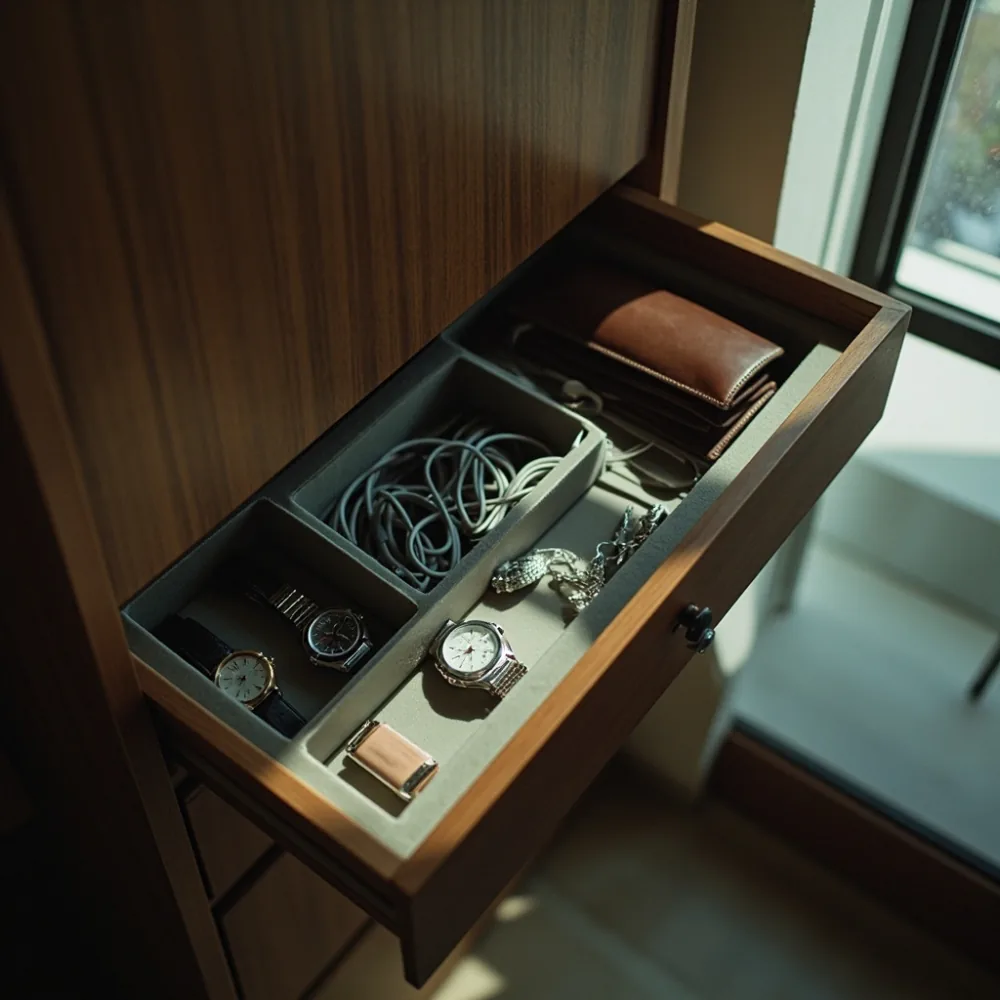
For wardrobe drawers specifically, the equation changes because you are usually storing heavier items: watches, cables, small leather goods, belts. I have moved all of mine into a felt-lined tray from a small maker on Etsy shipping from Kuala Lumpur; total cost including delivery was $78 SGD and it has held up for two years of daily use. For a leather sofa or solid wood wardrobe context, the felt tray visually matches the rest of the room without screaming "plastic organiser from the warehouse".
Frequently asked questions
How do I measure my HDB drawer correctly for a new organiser?
Pull the drawer out fully and measure the internal width at the front opening, the internal depth from the drawer face to the back panel, and the internal height from the base to the underside of the drawer top. Take all three numbers in mm and subtract 8-10 mm from each to allow for easy insertion. Most 4-room BTO kitchen drawers measure 380-420 mm wide, 460-500 mm deep, and 50-70 mm tall internally.
Are bamboo organisers suitable for Singapore humidity?
Thin bamboo under 10 mm tends to warp and gap at the joints within 9-15 months in a HDB kitchen because indoor humidity often sits at 70-82% RH. Thick lacquered bamboo at 15-20 mm holds up for 4-6 years. Solid rubberwood or ash with proper kiln-drying and six-side sealing is the most durable option and can last 8-12+ years even in coastal districts.
What is the average cost of a good drawer organiser in Singapore?
Plastic and thin bamboo trays range from $12 to $55 SGD and last 1-4 years. Thick lacquered bamboo runs $35 to $75 SGD and lasts 4-6 years. Solid wood custom trays from local carpenters cost $90 to $180 SGD and last 8-12+ years. Add $15 to $60 SGD for delivery unless you self-collect from Tai Seng or Sungei Kadut.
How long does custom drawer organiser delivery take in Singapore?
Local bespoke carpenters in Eunos or Ubi typically deliver in 10-14 days. Overseas solid-wood furniture makers shipping by sea from Foshan take 28-42 days including production, sea freight via Yantian, customs clearance, and final delivery to your door. Sea freight shipping is usually free above $300 SGD, otherwise expect $35 to $60 SGD.
Can drawer organisers be used in wardrobe drawers too?
Yes, and I recommend felt-lined or solid wood trays for wardrobe drawers storing watches, cables, belts, and leather goods. Master bedroom wardrobe drawers in most Singapore condos measure 500-800 mm wide and 400-450 mm deep internally, which gives room for a 6-8 cell tray plus a small jewellery insert. Felt matches the rest of a solid wood or leather sofa bedroom setting visually.
Questions about specifications, fabric or delivery? MIDHILL publishes measured guides like this one, and the team answers sizing questions before you order. See the full collection or contact the team.