How Humidity in Southeast Asia Affects Wood Furniture (And What to Do About It)
Last month, I visited a customer on the flat in Tampines who had just moved into a 4-room HDB. Her three-month-old solid wood dining table had developed a 4 mm cup at the wide end of the tabletop. The humidity reading on her bedroom hygrometer sat at 86%. Within twenty minutes, we had pulled the table away from the wall, wedged two cork shims under each leg, and put a 1.2 kg calcium chloride tub in the cupboard below. By the following Saturday, the cup had dropped to under 1 mm. The fix was not a miracle, just a measured response to the climate we live in.
Singapore's average relative humidity runs between 78% and 82% year-round, with afternoon peaks that cross 90% during the December to February monsoon surge. For wood furniture, that figure is not a curiosity; it is a working condition. At MIDHILL, where we have shipped solid wood pieces into 15+ countries since 2008, our factory in Foshan is actually drier than most Singapore homes. The pieces that arrive on our customers' corridors have to make a quick adjustment, and the customers who understand that adjustment keep their furniture looking right for ten years and longer.
What humidity actually does to a solid wood dining table or bed frame
Wood is hygroscopic. It exchanges moisture with the surrounding air every hour of every day. A solid wood dining table made from oak or ash will gain moisture in August and lose it in January. The movement is small, but it is real and measurable.
Here is what we see in customer photos and during in-home visits around Bedok, Punggol, and Toa Payoh:
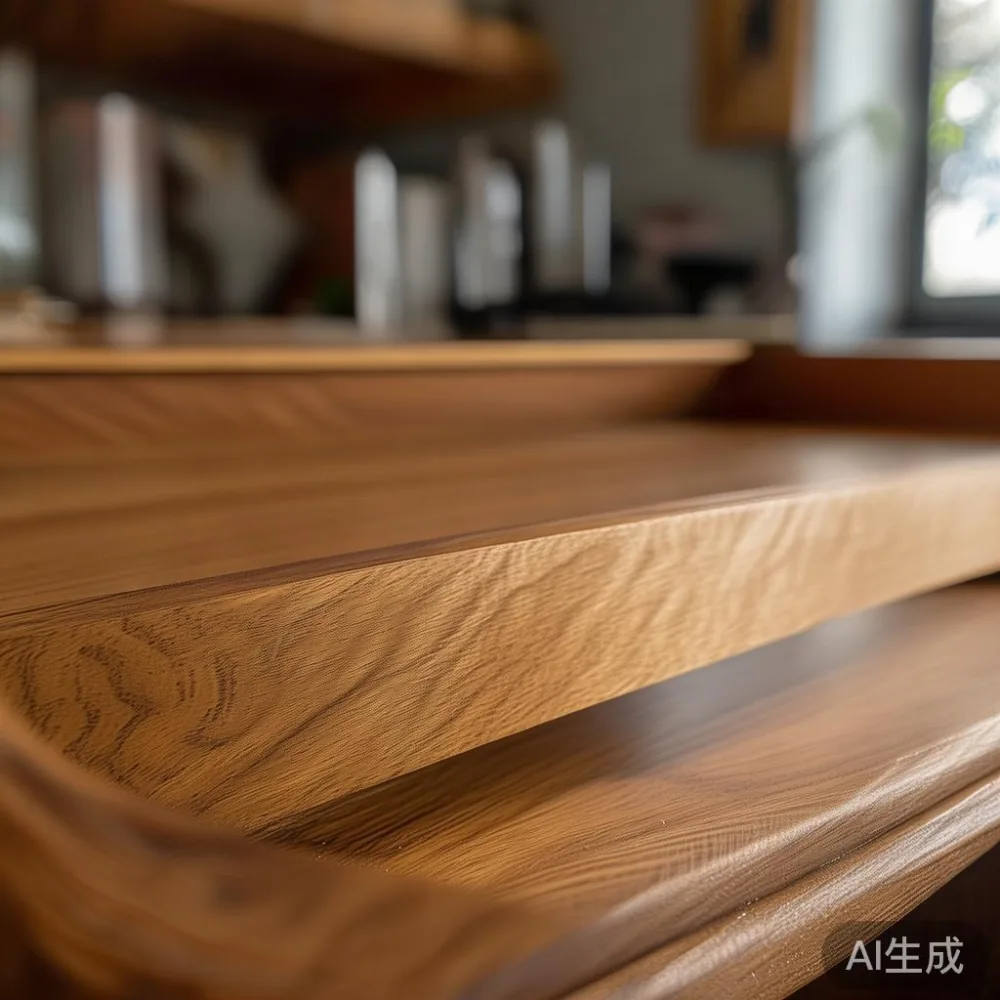
1. Cupping on tabletops. The far edge of a 180 cm oak slab can rise 3 to 6 mm when humidity climbs past 85% for two weeks. The same slab flattens when the indoor reading drops below 65%.
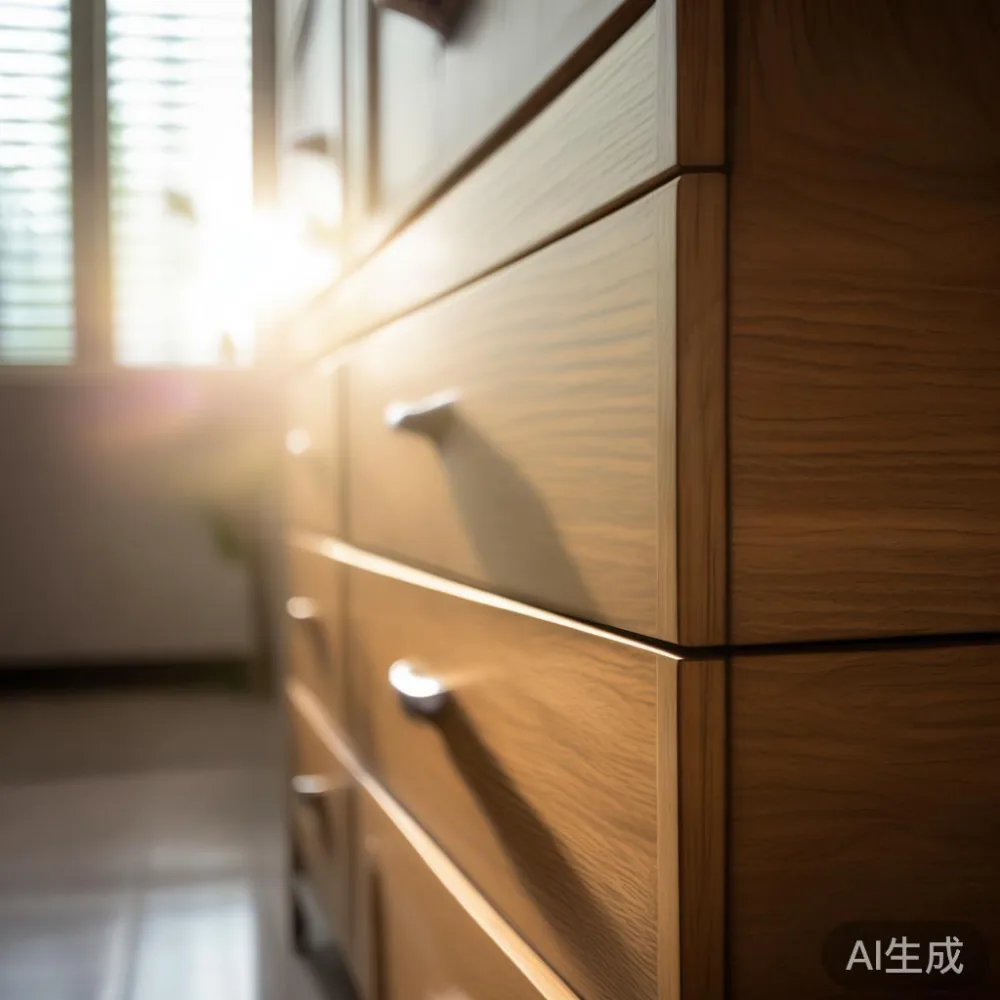
2. Drawer stick. A bedside nightstand drawer that slides smoothly in our Foshan workshop can bind by 1 to 2 mm once it sits in a non-air-conditioned spare room for a month. The wood swells, the cavity shrinks, the fit tightens.
3. End-grain checks. The short ends of a dining table leaf are the first place a crack will appear. We seal them in the factory, but a six-month cycle of swelling and shrinking eventually opens a hairline check under 0.5 mm wide.
4. White water marks. A cold glass left on an unprotected tabletop can leave a milky ring within 15 minutes at 85% humidity. The finish traps the moisture beneath it.
5. Musty drawer-organizer smell. Felt-lined drawer organizers absorb ambient moisture. In a condo with the door often closed, that felt can hold a sour smell for days. Cedar pulls the opposite, but open the drawer and air it first.
None of these failures is structural. The ten-year structural warranty we ship with every MIDHILL piece covers joints, dowels, and frame integrity. Humidity-related movement is a maintenance issue, not a defect. Knowing the difference saves a customer from an unnecessary service request and saves us from shipping a replacement that was never needed.
Why Singapore's climate is harder on furniture than most people expect
Three conditions stack on this geography and make it tougher than, say, a Beijing apartment in winter or a Melbourne terrace in summer.
1. The humidity floor is high. Even on a dry February afternoon, indoor humidity in a Punggol Point Room without air-conditioning sits around 72%. Wood wants a 45% to 60% range. Your furniture starts every day already 12 to 30 points above its comfort zone.
2. The corridor and lift access is tight. Many older HDB blocks have a 1.1 m-wide lift door and a 0.9 m-wide stairwell turn. A 1.6 m headboard or a 1.9 m dining tabletop has to come up the service lift. Our delivery team carries felt blankets and a 2.4 m ratchet strap for a reason; bumping raw wood through a Tampines lift lobby removes lacquer that the factory took two days to apply.
3. Air-conditioning creates a 15 to 25 point swing. You run the AC at 24°C from 11 p.m. to 7 a.m. The bedroom reads 52%. You turn it off at 7 a.m. By noon, it reads 78%. A solid wood bed frame cycles through that swing every single day. After 90 cycles, the joints start to creak. After 365, you hear a small tick at 3 a.m. when the wood contracts.
The remedy is not to fight the climate; it is to soften the swing. A 1.2 kg calcium chloride tub in the wardrobe absorbs about 250 ml of water over a 30-day window. A small dehumidifier rated at 6 L per day costs S$119 at the nearest Tampines Mall. Either one keeps the indoor reading in a 60% to 70% range, which is the band where solid wood stays still.
How much does a extendable dining table cost in Singapore?
A six-seat extendable solid wood dining table in Singapore typically costs between S$1,450 and S$3,200 before GST for a 160 cm to 200 cm configuration in oak or ash, with a 9% GST adding roughly S$130 to S$290 at checkout. The price moves with the extension mechanism, the leaf count, and the freight class to your floor corridor.
Three things set the price apart from one to another. First, a single-leaf extension that stores inside the table runs S$1,450 to S$2,100. A two-leaf butterfly extension that opens to 220 cm runs S$2,100 to S$2,800. A three-leaf on a steel-tracked runner runs S$2,800 to S$3,200. Second, oak prices have climbed 18% since 2023 because of tighter European FSC quotas. Ash is 12% cheaper than oak for a comparable board foot. Third, freight to a Punggol Waterway unit on the 14th floor via service lift costs S$90 to S$140, which includes two men, a moving blanket, and a 2.4 m ratchet strap. The same piece to a landed property in Bukit Timah adds S$60 because the truck can park at the kerb.
For a four-seat family in a 4-room HDB, the S$1,450 to S$2,100 single-leaf band is the right zone. Six-seat households entertaining on weekends should sit in the S$2,100 to S$2,800 band. Anything above S$3,200 is custom joinery for a specific layout, and the 10-year structural warranty we offer starts to count for more than the price difference. We ship from our Foshan factory in 28 to 35 days to a Singapore forwarder, and door-to-door typically lands at 38 to 45 days including sea freight and the final mile. Free shipping kicks in above US$350, which translates to roughly S$475 at today's 1.35 rate, so most solid wood dining table orders cross that threshold naturally.
What about the bedroom and the wardrobe? Does humidity hit a bed frame or nightstand the same way?
Yes, and arguably harder. A solid wood bed frame carries headboard, footboard, side rails, and slats. Each one has its own grain direction and its own swelling rate. A queen-size frame made of ash and standing in a Punggol bedroom with the AC running 8 hours a night will move about 2 mm laterally over a year. That movement shows up as a faint creak at the slat-to-rail joint, the same sound that wakes customers at 3 a.m. and convinces them the bed frame is broken. It is not broken. The joint is just dry.
A French light luxury nightstand with a marble top and a single drawer costs between S$720 and S$1,150 before GST. The marble top is the part of the suite that humidity cannot touch; marble does not move. The wooden carcass and the drawer box below it can swell by 1.5 mm across the width of the drawer face in a humid week. A felt drawer organizer inside the drawer will then stick against the side wall. The fix is a 30-second pass with a 320-grit sanding sponge on the drawer side, not a service call.
For wardrobes, the same rule applies but the scale is bigger. A three-door solid wood wardrobe is 180 cm tall and 180 cm wide. Across that width, a 1 mm movement is invisible. On a door gap that the factory set at 2.0 mm, that 1 mm is a 50% change. You will hear the door rub the felt bumper in August and feel it loose in February. We set our gaps at 2.5 mm at the factory precisely so a 1 mm swing in either direction still leaves a working clearance. Refinishing is free for life on every MIDHILL piece, so a door gap that drifts beyond 1.5 mm can be reset at our service centre for a one-way shipping fee of S$45.
What everyday habits actually protect a piece, and which ones are myths?
After ten years of shipping into Singapore, the MIDHILL team has a short list of habits that work and a short list that do not.
Habits that work:
- Run a hygrometer. A S$22 digital unit from a neighbourhood shop is enough. Aim for 55% to 65%. Anything above 75% for a week will start moving your furniture.
- Keep furniture 8 to 10 cm off an external wall. The Bedok wall against the service yard stays 2 to 3 degrees cooler than the room at night. Condensation forms on the back of a wardrobe and soaks into the back panel.
- Use felt drawer organizers inside every drawer. They buffer the wood against humidity swings and they stop the drawer organizer smell that comes from trapped moisture. We ship a set with every nightstand and every bedside table we sell.
- Wipe with a barely damp microfibre cloth once a week. Dry dusting spreads dust and scratches the lacquer. Damp dusting lays a fine moisture film that evens out the local humidity at the surface.
- Lift, do not drag. Dragging a 28 kg oak dining chair across a marble table surface removes 0.05 mm of lacquer per pass. Lift it. The chair weighs 6 to 7 kg. Your back can take 7 kg.
Habits that do not work:
- Hairdryer on a warped drawer. The heat cracks the lacquer and the wood stays warped once it cools.
- Beeswax every month. A monthly coat of beeswax traps moisture under the film and turns the surface cloudy after six months.
- Plastic sheet under a wardrobe. The sheet traps condensation against the wood and accelerates swelling at the bottom.
- Leaving the AC off for a week on holiday. The Punggol bed frame goes from 52% to 86% in seven days. On your return, the slats creak, the drawer organizer is damp, and the marble table has a white ring from the overnight condensation drip on the underside of the glass vase.
One more number worth keeping. Solid oak moves roughly 0.2% across the grain for every 4% change in humidity. A 180 cm dining tabletop at 4% swing will move 1.4 mm. That is the same 1.4 mm you saw on your friend's Tampines dining table last Christmas. It is not a defect. It is wood.
How does light luxury positioning change the maintenance story, if at all?
An American light luxury solid wood sofa with a 1.2 mm PU finish and a kiln-dried oak frame behaves the same as a French light luxury suite with a 1.8 mm hand-rubbed shellac. The wood moves. The finish sits on top. The humidity affects the wood, not the finish, until the finish cracks.
What changes with a light luxury piece is the visible tolerance. A post-modern light luxury dining table with a marble insert and a tapered ash base shows movement faster than a rustic farmhouse table with a thick polyurethane seal. The eye reads the crisp 90-degree corner as a reference line. A 1.5 mm shift at that corner is obvious. A 1.5 mm shift on a 40 mm chamfered edge is invisible.
Practical implications:
- A post-modern master bed for small apartment in a 3-room HDB will benefit from a 60 cm clearance on each side, so air circulates and the humidity stays even.
- A French light luxury nightstand with a marble top is more forgiving on humidity than an all-ash equivalent, because the marble locks down half the surface area.
- An American light luxury solid wood sofa frame with pocketed coil springs and feather cushions feels the same in February and August. The cushions absorb the room's humidity before the wood does.
If you are choosing between an oak dining table at S$1,650 and a teak dining table at S$2,150, the moisture edge belongs to teak. Teak moves 0.12% across the grain for every 4% humidity change. Oak moves 0.20%. For a 180 cm tabletop, that is 0.54 mm against 0.90 mm at the same swing. Teak costs 30% more up front, but it costs the same in maintenance over ten years. The warranty and the lifetime refinishing are identical either way.
What does MIDHILL do at the factory that most buyers do not see?
Three things that affect how your piece behaves once it reaches your Tampines or Punggol address.
1. Kiln-dried to 8% to 10% moisture content. We dry our oak, ash, and walnut in a dehumidification kiln for 28 to 45 days, depending on board thickness. 8% is below the equilibrium moisture content of a Singapore home, so the wood will pick up 1% to 2% once it lands. That is a controlled, predictable pickup that the joints are designed around.
2. Quartersawn boards for tabletops. A quartersawn oak board moves 0.10% across the grain for every 4% humidity change, against 0.20% for a plain-sawn board. We quartersaw the top 18 mm of every solid wood dining table we ship because that is the surface that shows the movement.
3. Felt-lined drawer organizers as standard. Every drawer we build ships with a 1.5 mm felt liner that buffers the wood against the contents and against the indoor humidity. It costs us S$3.40 per drawer to fit. We do not charge for it.
We also test every batch in a humidity chamber at 80% for seven days before shipping. If a tabletop cups more than 0.8 mm under that test, it does not ship. The test reads at 0.3 mm to 0.5 mm on a good batch. Yours is the batch that passes.
Frequently asked questions from Singapore customers
Will my wardrobe door warp in the first year? It can drift 1 to 2 mm across the width, which shows up as a tighter or looser door gap. The doors are built with 2.5 mm gaps at the factory so a 1 mm drift is still workable. If the gap closes below 1.0 mm, our lifetime refinishing covers a reset at our service centre for a S$45 one-way shipping cost.
Can I keep a piece in a non-air-conditioned storeroom? For short periods, yes. A storeroom that reads 80% for two weeks will cup a tabletop by 1 to 2 mm. A storeroom that reads 80% for six months will cup a tabletop by 3 to 5 mm and may check the end grain. Treat the storeroom as a short-term parking spot, not a long-term home.
Does the 14-day return policy cover humidity movement? The 14-day return covers factory defects and transit damage. Cupping, white water marks, and drawer stick from in-home humidity are not covered because the wood is doing what wood does. The fix is sanding, shimming, dehumidifying, and time, not a return.
What if my marble table gets a ring? Marble is not wood, so humidity is not the cause. The cause is usually coffee, tea, or citrus. We can refinish the marble surface under our lifetime refinishing for a S$65 service fee.
How long does delivery take from order to my door? Production is 28 to 35 days, sea freight to Singapore is 10 to 14 days, customs clearance is 2 to 3 days, and the final mile to a Tampines or Bedok unit is 1 to 3 days. Door-to-door, 42 to 55 days. Free shipping kicks in above US$350 (about S$475).
A short care routine for a Singapore home
Three habits, ninety seconds each, every Sunday. That is what keeps a solid wood dining table, bed frame, or wardrobe looking like the piece you bought.
Sunday morning, 60 seconds. Walk the home with the hygrometer. Note the highest reading. Anything above 75% for a week means the dehumidifier stays on through the night for the next seven days.
Sunday afternoon, 90 seconds. Damp-wipe every tabletop with a microfibre cloth. Barely damp, not wet. The cloth should feel almost dry in your hand. Wipe along the grain. Lift the felt drawer organizers out, air them for 30 seconds, replace them.
Sunday evening, 30 seconds. Pull every chair 4 cm out from the dining table and slide it back in. The motion oils the floor pads and evens out the contact patch.
Three minutes per week. That is the entire maintenance budget for a S$2,200 solid wood dining table, a S$1,650 solid wood bed frame, and a S$1,950 three-door wardrobe. The 10-year structural warranty covers the joints. The lifetime refinishing covers the surface. The three-minute routine covers everything in between.